
To advise the authorities on the Italian island on the issue | The locusts on the island destroyed 500,000 dunams of crops, and the affected farmers are still waiting for compensation from the state.
An Israeli delegation has set out to help eradicate the ongoing locust attack in Sardinia, following a request from President Christian Salinas. The locust plague that has been plaguing the Italian island of Sardinia in recent times is causing enormous damage. Last month, Salinas contacted the Israeli ambassador to Italy, Dror Idar, requesting assistance from the State of Israel in dealing with the ongoing phenomenon. Israel is considered a world expert in the field of locust swarm control.
The island of Sardinia is a tourist attraction that attracts tourists from all over the world. The island’s residents earn their living mainly from agriculture and fishing, and for the past three years have been dealing with a devastating locust attack. The swarms, which arrived a month earlier than in previous years, number millions of grasshoppers. The Italian Farmers’ Association estimates that this year crops were destroyed on about 500,000 dunams. The area hardest hit is the province of Nuoro. The Moroccan locusts are capable of flying 150 kilometers each day. The association estimates that if control is not achieved soon, a real threat is expected to the food security of the island’s residents.
According to Leonardo Salis, president of the Italian Farmers’ Association in the province of Nuoro, farmers have been demanding that state authorities address the problem for three years, and have even put forward proposals for dealing with the locusts. “We are shocked that we still find ourselves talking about the locust invasion. Farmers are disappointed. Some have changed their crop plan to try and limit the damage because they were afraid that nothing would change.” Despite their demand, the farmers have still not received compensation for the damage caused in previous years.
Salinas also expressed support for compensating farmers, telling the local newspaper L’Unione Sarda last month: “The locust invasion has devastated the province of Nuoro and brought several (agricultural) companies to their knees. The compensation is essential to allow farmers to cope with the sharp drop in their income, and will ensure concrete support in the face of the emergency that has added to the difficulties they have been experiencing in recent years.”
Nighttime pest control from the ground and air
A professional delegation from the Ministry of Agriculture, led by Dr. Yoav Motro, traveled to the island, located in the Mediterranean Sea, southwest of Italy. The delegation was attended by representatives of prominent Israeli agro-tech companies in the field, specializing in locust control in Israel and Africa. The delegation made a quick visit to assess the spread of locust swarms in the area, and met with Salinas, senior managers, and Italian field personnel. The team’s conclusions and recommendations for handling the situation were presented to the Italian professionals.
Professionals from the Ministry of Agriculture, in conjunction with ALTA and Muller Professional Pest Control, have developed an original method for dealing with locust swarms at their greatest weak point, while incorporating advanced aerial systems for locating and spraying the locusts.
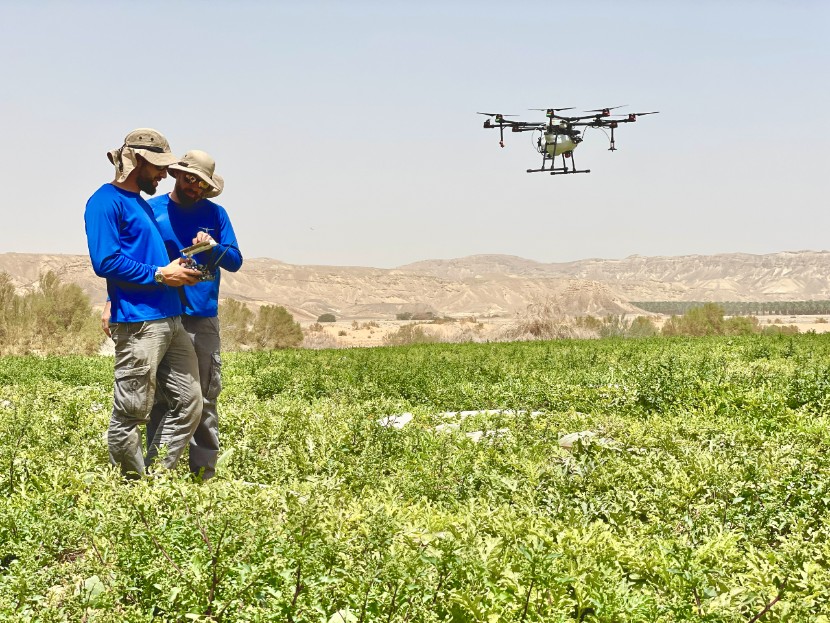
An examination revealed that during the day, locust swarms fly with the wind and are in constant motion, which makes pest control difficult. In contrast, towards nightfall, the swarm prepares to settle in a spot where it will remain for the entire night, where it is most vulnerable. Pest control is carried out using various methods, including ground spraying, aircraft, or dedicated drones, depending on the size of the swarm.
Locusts. The Italian Farmers’ Association foresees a real threat to the food security of the people of Sardinia (Photo: ALTA)
An Israeli delegation has set out to help eradicate the ongoing locust attack in Sardinia, following a request from President Christian Salinas. The locust plague that has been plaguing the Italian island of Sardinia in recent times is causing enormous damage. Last month, Salinas contacted the Israeli ambassador to Italy, Dror Idar, requesting assistance from the State of Israel in dealing with the ongoing phenomenon. Israel is considered a world expert in the field of locust swarm control.
The island of Sardinia is a tourist attraction that attracts tourists from all over the world. The island’s residents earn their living mainly from agriculture and fishing, and for the past three years have been dealing with a devastating locust attack. The swarms, which arrived a month earlier than in previous years, number millions of grasshoppers. The Italian Farmers’ Association estimates that this year crops were destroyed on about 500,000 dunams. The area hardest hit is the province of Nuoro. The Moroccan locusts are capable of flying 150 kilometers each day. The association estimates that if control is not achieved soon, a real threat is expected to the food security of the island’s residents.
According to Leonardo Salis, president of the Italian Farmers’ Association in the province of Nuoro, farmers have been demanding that state authorities address the problem for three years, and have even put forward proposals for dealing with the locusts. “We are shocked that we still find ourselves talking about the locust invasion. Farmers are disappointed. Some have changed their crop plan to try and limit the damage because they were afraid that nothing would change.” Despite their demand, the farmers have still not received compensation for the damage caused in previous years.
Salinas also expressed support for compensating farmers, telling the local newspaper L’Unione Sarda last month: “The locust invasion has devastated the province of Nuoro and brought several (agricultural) companies to their knees. The compensation is essential to allow farmers to cope with the sharp drop in their income, and will ensure concrete support in the face of the emergency that has added to the difficulties they have been experiencing in recent years.”
Nighttime pest control from the ground and air
A professional delegation from the Ministry of Agriculture, led by Dr. Yoav Motro, traveled to the island, located in the Mediterranean Sea, southwest of Italy. The delegation was attended by representatives of prominent Israeli agro-tech companies in the field, specializing in locust control in Israel and Africa. The delegation made a quick visit to assess the spread of locust swarms in the area, and met with Salinas, senior managers, and Italian field personnel. The team’s conclusions and recommendations for handling the situation were presented to the Italian professionals.
Today’s Word Every morning in your emailRegister
By logging in, I agree to the terms of use of the site.
Professionals from the Ministry of Agriculture, in conjunction with ALTA and Muller Professional Pest Control, have developed an original method for dealing with locust swarms at their greatest weak point, while incorporating advanced aerial systems for locating and spraying the locusts.
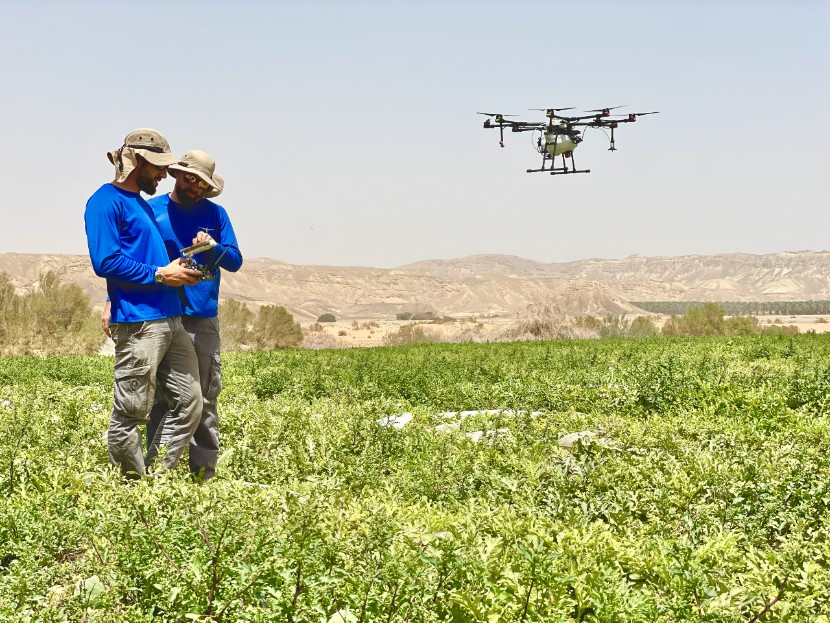
Locust control using a drone. The last locust attack in Israel, in April 2021 in the Arava, ended in less than two weeks (Photo: ALTA)
An examination revealed that during the day, locust swarms fly with the wind and are in constant motion, which makes pest control difficult. In contrast, towards nightfall, the swarm prepares to settle in a spot where it will remain for the entire night, where it is most vulnerable. Pest control is carried out using various methods, including ground spraying, aircraft, or dedicated drones, depending on the size of the swarm.
In Israel, in Sardinia – and also in the Third World
Over the past year, an assistance plan was written and implemented for African countries to deal with the locust attack. The assistance includes technological equipment and knowledge on the subject, which is transferred to locals in a week-long training workshop.
“Israel is known as a country that successfully fights the invasion of locust swarms from time to time into its territory,” said Agriculture Minister Oded Forer. “The treatment is becoming more efficient with each encounter, and thanks to our experience and success both in Israel and in assisting in other places around the world, we receive requests for assistance from various places around the world. In this case too, we gladly complied.”
Locusts are not directly harmful to humans or animals, but they are a significant nuisance and can cause serious damage to agricultural crops. In Israel, the Plant Protection and Inspection Services of the Ministry of Agriculture are responsible for managing locust swarm outbreaks. The work procedure includes tracking and monitoring locust swarms at all stages of their life cycle, which allows for precise methods of action to prevent damage to local agriculture. Field teams in areas where locust swarms have been detected use advanced technology that helps monitor the locust’s developmental stages, location, etc., in order to accurately control them. The last case of a locust attack in Israel occurred in April 2021 in the Arava region. Thanks to combined efforts, the event ended in less than two weeks.
According to Motro, the leader of the Ministry of Agriculture’s locust war, the common locust in Sardinia is the Moroccan locust, compared to Israel, where the desert locust, which originates in Sudan, is common. Control attempts in Sardinia have been ongoing for three years, but without much success. Unlike the desert locust, the Moroccan locust does not migrate to Sardinia, but rather strengthens local populations there. The Moroccan locust is more “predictable” spatially, since it is possible to predict where it comes from and where it is moving, but dealing with the problem is similar and requires special attention from several authorities.
“After two days in the locust areas in Sardinia, we can say that the severity of the situation is moderate,” said Motero. “We were happy to provide treatment recommendations regarding the timing and nature of spraying, which include precision pest control, mainly at night, as well as monitoring, mapping and pest control technologies that we developed in Israel.”
Israel and Sardinia are among the only developed countries that are dealing with the locust problem. According to Dr. Motro, the combination of technology and science is advancing the fight against this ancient agricultural pest. “I think there is even more value in advancing locust control methods than protecting Israel, Sardinia, or the relationship between them. It will help the weaker countries of the world , where locusts lead to the atrocity of famine, and I am proud to be part of this treatment.”